Claude can now read your bank accounts and tell you where your money goes. To let it, you pay for a plan and sign in to your bank through Plaid.
Spentio skips both. Upload your statement, as a PDF or a photo from your banking app, and about a minute later your spending is sorted. Free, and you never sign in to your bank.


What is Claude Personal Finance?
Personal Finance is the money feature in Claude, launched by Anthropic as a beta on November 5, 2026. You connect your accounts through Plaid, an outside service that links apps to banks, and Claude answers your questions about your spending. According to Anthropic's help page:
- Paid plans only. Pro, Max and Ultra. Pro, the cheapest, costs $20 a month or $200 a year.
- US banks only, up to 16 of them.
- Up to 24 months of transactions.
- Investments as a balance only. No holdings, no trades.
ChatGPT's Finances works the same way, through Plaid.
Spentio vs. Claude Personal Finance
| Spentio | Claude Personal Finance | |
|---|---|---|
| Signing in to your bank | ✅ Never | ❌ Required, through Plaid |
| Free plan | ✅ Reads your statements in full | ❌ Paid plans only |
| History | ✅ Every year your statements cover | ❌ Up to 24 months |
| What you share | ✅ Only the statement you upload | ❌ Every transaction in your linked accounts |
| Banks | ✅ Any bank in the world | ❌ US banks only |
| If you stop paying | ✅ Nothing to disconnect | ❌ Anthropic keeps access to your bank |
| Dashboard and budgets | ✅ Stay, no connection involved | ❌ Gone when you unlink your last bank |
| Investments | ✅ Holdings, gains and dividends | ❌ Balance only |
| Apple Pay | ✅ Logged the moment you pay | ❌ Only what the bank reports |
Spentio: upload your statement, done
Upload your statement, as a PDF or a photo from your banking app. About a minute later, every transaction is categorized and your subscriptions are found. You approve what it found, and your month is done.
It works with any bank in the world. Upload last year's statements, or five years' worth, and your whole history is there on day one.
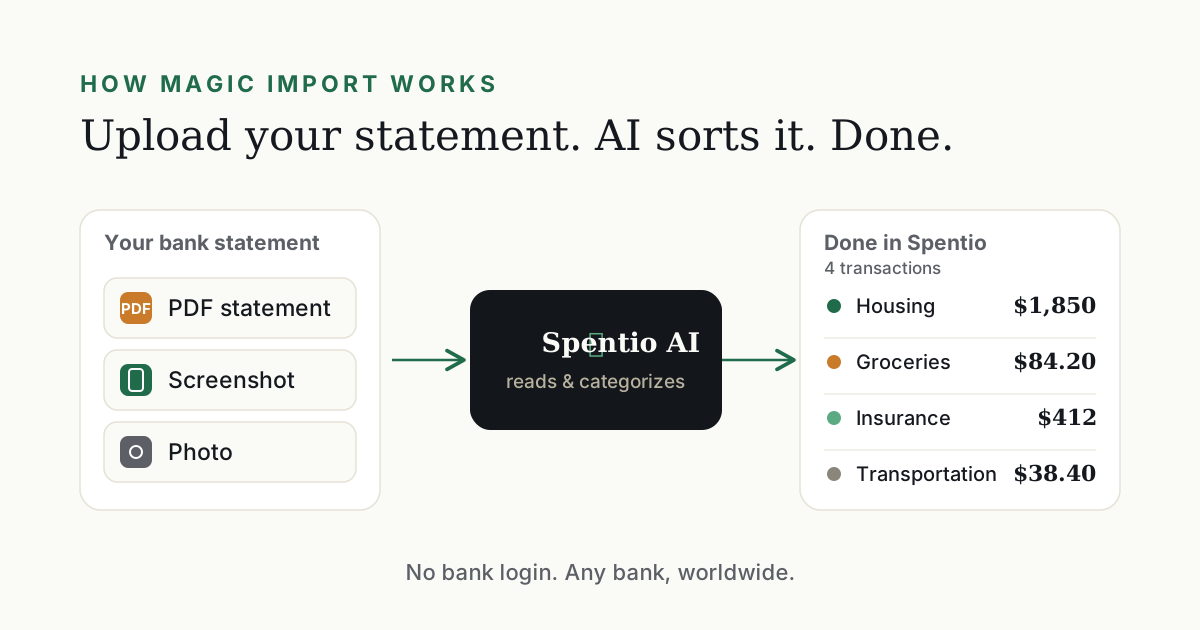
Spentio updates when you decide: one statement a month, and nothing to re-link in between.
What you get with Spentio
Your bank login stays yours
You never sign in to your bank for Spentio, directly or through another service. Download your statement from online banking the way you always do, then upload it. Wondering whether it's safe to link your bank to an app? Here, nothing gets linked.
Who else has access to your bank?
With Claude Personal Finance, two companies that aren't your bank do: Plaid and Anthropic. Once you link your accounts through Plaid, Claude can look at them at any moment, without asking you each time. And that access doesn't expire: even if you cancel your subscription, Anthropic keeps it until you revoke it.
With Spentio, nobody does. There's no connection to your bank, and what you share is always your call.
A free budget app, for real
The free plan reads your statements in full, on the web and on iPhone, and you don't need a credit card to sign up. It's the fastest way out of your spreadsheet, or off Monarch's yearly bill.
Your full history, not just two years
Your statements decide how far back you go, not a bank connection. Spentio shows you which months are still missing for each bank. If your history disappeared when Mint shut down, this is how you rebuild it.
Logged the second you pay
Pay with Apple Pay on your iPhone and the expense shows up in Spentio with the amount, merchant and category filled in. Paid in cash? Adding it takes seconds.
Heads-ups that come early
Your phone gets a nudge the day before a recurring bill hits, when you're on pace to blow through a budget, and early in the month if last month's statement is missing. On iPhone, home screen widgets show this week's bills and your budgets at a glance.
Your investments, right next to your spending
Stocks, ETFs and the major coins in one place. Upload your brokerage statement and Spentio pulls in the buys, sells and dividends, so you can see what each position has earned and whether you're beating the market.
Budgets that check themselves
Every budget shows you, day by day, whether the money will make it to the end of the month. Control compares your budgets with what you actually spend and calls out what's off: a cap set too low, one set too high, a charge that keeps coming back and belongs with your recurring bills.
See up to ten years ahead
Forecast maps out your bills, budgets and goals month by month, as far as ten years out, and shows what's left over. Turn off a payment or bump up a budget, and you see the result before you commit.
And plenty more
- Friends paying you back: only your share of dinner counts.
- Installments: split a purchase and see every payment before it hits.
- Objects: what your car, your house or your dog really costs, in one number.
- Money Mix: how much of your month went to needs, how much to wants, and how much you never planned.
- Goals: money you set aside for a goal gets counted automatically.
- Recurring: paychecks, rent and subscriptions show up on their due date, on their own.
- Benefits cards: each one with its own balance.
- Multiple currencies: every account in its own currency, all added up in yours at the day's rate.
Privacy: you decide what's shared
Linking your bank hands over a master key. And with Claude Personal Finance, what Claude said about your money stays in your chats until you delete it.
With Spentio there's no key. The PDF is deleted the moment its text is read, and your statements are never used to train AI models. What you save in Spentio is stored in Switzerland, under Swiss and EU data protection law. Export all your transactions as CSV whenever you like, and delete your Spentio account, with everything in it, in one step. The details are in the privacy policy.
The bottom line
Claude Personal Finance asks for a paid plan, a bank sign-in and a link that stays open. Spentio asks for your last statement: free to start, any bank, years of history and no login. Start free.